By Right Of Centre UK
Once again, a European city center becomes a war zone, and once again, the public is expected to swallow a hollow narrative.
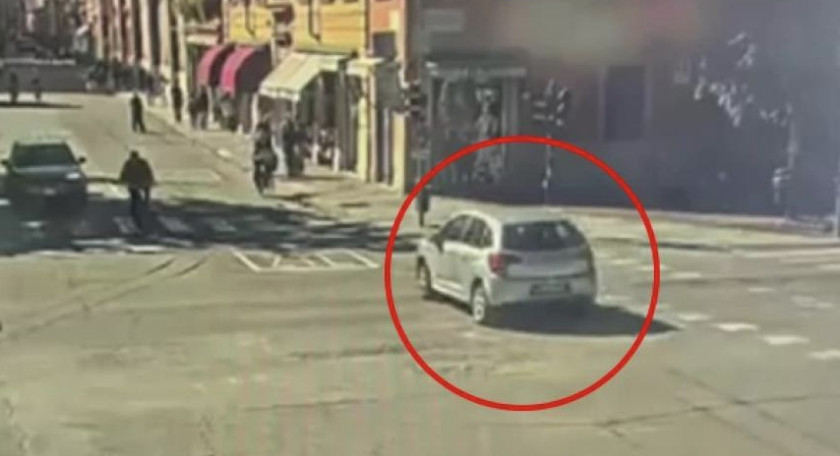
On Saturday afternoon in Modena, a grey Citroën plowed through pedestrians at 100 km/h, tossing citizens into the air before pinning innocent shoppers against a storefront. Eight people were injured—four critically—leaving two female tourists from Poland and Germany with horrific, life-altering amputations. But it is what happened after the rubber met the glass that exposes the true nature of this atrocity. The driver didn’t freeze or collapse in confusion; he unbuckled his seatbelt, stepped out of the wreckage, pulled a knife, and immediately began hunting down survivors, engaging in an 11-second knife fight with brave bystanders who risked their lives to subdue him.
It is a play-by-play execution straight out of a lethal playbook. Yet, within 24 hours, Italy’s Ministry of the Interior and local prosecutors did exactly what the public has come to expect: they officially downplayed terrorism, attributing the carnage entirely to the suspect’s “schizoid mental disorders.”
We are told to believe that Salim El Koudri—an economics graduate of Moroccan origin—simply had a sudden, isolated psychiatric break. But for a public exhausted by elite double standards, this explanation flies in the face of common sense.
The Dual-Phased Playbook
Let’s be entirely clear about the facts: millions of people worldwide struggle with severe mental health crises every single day. They suffer from delusions, depression, and psychoses. Yet, they do not default to highly specific, multi-staged tactical maneuvers to maximize civilian casualties.
Furthermore, the public cannot help but notice a highly conspicuous, deeply unsettling pattern: when these supposedly random psychiatric breaks manifest as highly coordinated vehicular and knife attacks against civilians, the perpetrators almost always seem to share the same background. It is a strange and telling coincidence that out of all the populations suffering from clinical mental illness, this specific method of violent expression consistently emerges from one demographic.
This is not an arbitrary manifestation of madness; it is the execution of a definitive, highly publicized blueprint popularized by groups like ISIS and al-Qaeda over the last decade. The instructions were simple and precise: Use a vehicle to crush the crowd, then exit the vehicle with a blade to finish the job. We have seen this exact, brutal play-by-play unfold on our doorsteps before. It is the identical tactical signature of the 2017 London Bridge attack, where extremists rammed a van into pedestrians before dismounting to slaughter innocent people with knives. Even more closely, it mirrors the devastating 2023 Nottingham attacks, where Valdo Calocane executed the exact same dual-phased horror—fatally stabbing two young students, Barnaby Webber and Grace O’Malley-Kumar, on their way home from a night out, murdering a school caretaker to steal his van, and then weaponizing that vehicle to deliberately plow into commuters at a city bus stop.
In the Nottingham case, the British establishment hid behind the exact same shield, classifying the slaughter as a “mental health crisis” due to Calocane’s schizophrenia. When an individual utilizes the exact synchronized method prescribed by global jihadist networks, calling it a mere “medical issue”—whether in Nottingham or Modena—is a direct insult to public intelligence.
False Dichotomy: Madness and Method Are Not Mutually Exclusive
The most dangerous flaw in the official narrative is the insistence that an act is either a mental health crisis or a terrorist attack. This is a false dichotomy designed to soothe public anxieties rather than face reality. The two things are not mutually exclusive.
A severe mental health issue does not magically disqualify an individual from committing an act of terrorism. In fact, modern counter-terrorism research shows they frequently overlap. Vulnerable, unstable minds are the primary targets for radicalization. A person can be clinically psychotic and still absorb, latch onto, and perfectly execute a specific ideological blueprint. When a broken mind acts out its delusions by weaponizing a vehicle and a blade against Western citizens, it has chosen a distinctly terrorist vehicle for its madness. The method was learned, the targets were chosen, and the playbook was followed. To claim it isn’t terrorism simply because the perpetrator has a medical file is a legal loophole, not a reflection of reality.
The Illusion of “Community Cohesion”
Even under the right-wing government of Giorgia Meloni—who rightly canceled her schedule to face this tragedy head-on—the state machinery has defaulted to a strategy of damage control. The rush to deny a civilizational or ideological link looks less like a rigorous forensic conclusion and more like a desperate attempt to force an artificial narrative of “community cohesion” that simply does not exist on the ground.
By categorizing these horrific acts as isolated medical anomalies, authorities attempt to manage public anger and shield communities from the uncomfortable realities of integration failures among second-generation citizens. Deputy Prime Minister Matteo Salvini was one of the few official voices to speak plainly, calling El Koudri exactly what his actions proved him to be: a criminal who has fractured the safety of the state.
Actions Define the Act
The legal system operates on a hyper-technical checklist. If prosecutors cannot find a signed manifesto or a digital smoking gun in a suspect’s chat logs, they claim there is no “ideological intent.”
But the public judges an act by its nature and its devastating consequences. If a man adopts the methods of a terrorist, targets the citizens of a Western nation like a terrorist, and inflicts the mass, dual-phased carnage of a terrorist, then he has committed an act of terrorism. To split hairs over whether an attacker was “more crazy” or “more radicalized” is a distinction without a difference to the victims whose lives have been permanently shattered. A broken mind does not magically invent a highly specific, multi-staged combat tactic. It absorbs it from a toxic cultural zeitgeist.
It is time for Western governments—even those on the right—to stop sugarcoating the threat to our streets. Whether driven by deep-seated ideological hatred or a mind warped by extremist propaganda, an attack on our civilization must be called what it is. To call the Modena massacre anything less than terrorism isn’t just naive—it’s dangerous. After all, if our governments and authorities continue to lie to the public about the true motives of these attackers, how can they ever hope to fight against them? You cannot defeat a threat you refuse to name, and you can never stop an enemy you are actively trying to cover up.